
If AI Flattens Organizational Hierarchies, How Will We Learn to Manage?
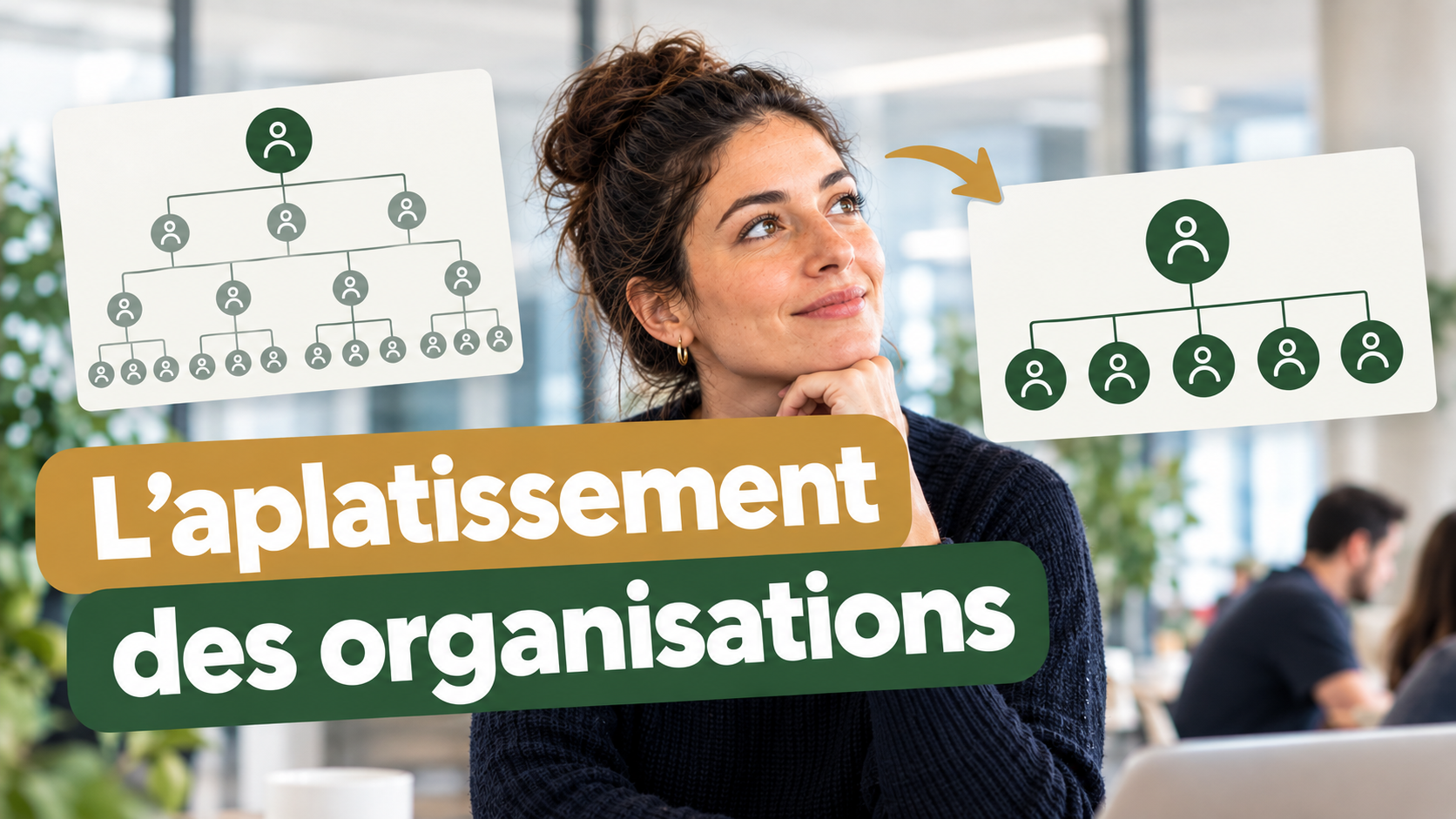
Fewer layers of hierarchy, larger and more complex teams, faster decisions. That is the promise of flatter organizations, and AI is accelerating it. Yet one question is flying under the radar: if we remove the first rungs of the ladder, how will managers learn to climb?
By Viviane de Tilleul
1. Fewer managers, larger teams.
In October 2024, Gartner predicted that by the end of 2026, 20% of organizations would use AI to flatten their structure, eliminating more than half of their middle-management positions. A prediction is not a measurement, of course, but the data is pointing in the same direction.
Gallup has been tracking the size of U.S. teams since 2013. The average number of people reporting to a manager increased from 8.2 in 2013 to 10.9 in 2024, and then to 12.1 in 2025. Nearly 50% more in twelve years, including more than one additional person in the last year alone. Gallup explicitly cites large tech companies eliminating management layers to expand team sizes.
Caution: the median remains stable, at around 5 to 6 people. The average is rising because some managers now have very large teams (13% manage 25 or more employees). Not everyone is affected.
Meanwhile, manager engagement is declining. According to Gallup's State of the Global Workplace 2026 (141,444 workers surveyed in 2025 worldwide), 22% of managers are engaged, compared with 27% in 2024 and 31% in 2022. Nine points lost in three years, including five in a single year.
Larger teams, therefore fewer managers for the same workforce, and managers who are doing worse.
2. Fewer and fewer candidates.
In France, Apec published its Cadres et management study in January 2026. Between 2022 and 2025, the proportion of non-managerial professionals who want to take on managerial responsibilities fell from 42% to 34%. Among those under 35, the drop is even sharper: from 63% to 47%, a 16-point decline.
The reasons are not mysterious. 24% of professionals say they are put off by managers' workload: 31% of managers report working 50 hours or more per week, compared with 11% of non-managers.
These figures can be read as a crisis of managerial ambition. They can also be read as a rational calculation. The job is getting bigger and more complex, while engagement is declining. Turning it down is not an irrational choice.
3. Learning "on the job" no longer works.
How did people learn to manage? Rarely in a training room. You became responsible for a team of three, then six, then twelve, with a manager one level above you within earshot to debrief. Nobody called it training. It was training nonetheless: a full-scale simulator, with limited stakes, where you could fail without breaking much.
This model had an obvious justification: the 70-20-10 model. 70% of learning was supposedly supposed to come from experience, 20% from others, and 10% from formal training. If you've read our first article, you can see where this is going. Clardy (2018) traced the sources of this figure. His verdict: the empirical support for the “70% or more” claim is weak, relying on approximate citations and incompatible definitions. His recommendation: abandon the rule.
That does not mean that experience teaches us nothing. It means that we don't know how much it teaches us, or under what conditions. And 70-20-10 served as a convenient excuse: why invest in practice if the job itself takes care of it?
Yet flattening organizations removes precisely the positions that used to serve as training grounds. Gartner acknowledges this in the same prediction: mentoring and learning pathways risk being disrupted, leaving more junior employees with fewer opportunities to develop.
Removing rungs doesn't eliminate the climb, but it makes it steeper.
4. How many repetitions are we losing?
Let's do the math. Let's call a “high-stakes situation” anything that makes a new manager sweat: reprimanding someone, arbitrating a conflict, turning down a raise, announcing an unpopular change, managing a departure. Assumption: 2 to 3 such situations per direct report per year (replace this with your own estimate; the reasoning still holds). Let's compare two career paths: the old one, with two years managing a small team before taking on a large one, and the new one, where you immediately take charge of 12 people (the 2025 Gallup average). We can count:
- Old ladder, before the large team: 2 years × 3 to 4 people × 2 to 3 situations
→ 12 to 24 repetitions, low-stakes, with a manager one level above available
- Flattened organization, first year: 12 people × 2 to 3 situations
→ 24 to 36 situations, in real-world conditions, with no prior repetition
So, roughly speaking: around twenty repetitions lost before taking the role, and 24 to 36 first-time situations to handle in the first year.
And the manager one level above who used to help debrief? In a flattened organization, they are also managing more people. So they are less available, precisely when they are most needed.
The first large team becomes the place where learning happens, when it should be the culmination of that learning.
5. And how much does a mistake cost when the team gets bigger?
In our article on management promotions, we estimated the cost of a failed promotion at €90k to €160k for a team of seven. Let's take just one component of that calculation, team underperformance during the period of reduced performance, using the same assumptions (~€55k fully loaded salary, 10 to 20% performance loss, 9 months), but with the average team size in 2025:
- Team underperformance: 12 people × €55k × 10 to 20% × 9 months
→ €50k to €99k, versus €29k to €58k for seven people
So, for this one component alone: a bill that rises by around 70%, mechanically, simply because the team has grown.
The reasoning is simple: costs that depend on team size increase with it. Induced turnover, for example, has no reason to be an exception. Now count: how many of your managers have taken on more than ten people at once over the past two years? And how many of them had already handled even a single difficult performance conversation before stepping into the role?
6. Rebuilding intentionally what the ladder once provided by accident.
If the job no longer provides the training, we need to train in another way. And we have a fairly good idea of what works. The meta-analysis by Lacerenza, Reyes, Marlow, Joseph & Salas (2017) covers 335 independent samples of leadership training. Three findings are relevant here:
- Practice. Programs that combine information, demonstration, and practice produce better learning outcomes than those limited to information.
- Feedback. Programs with feedback produce significantly better transfer of behavior to the workplace than those without feedback.
- Iteration. Multiple sessions spread over time perform better than a single, massed session.
This is exactly what the old ladder provided without anyone calling it that.
Gallup adds another clue. When employees clearly feel that they received useful feedback during the week, around 7 in 10 are engaged, regardless of team size. Otherwise, 1 in 4. This is a correlation, not proof of causality. But it tells us what is now expected of a manager with 12 people: 12 useful pieces of feedback per week. You don't improvise that; you practice it.
Gallup's response is to better select managers capable of leading large teams. We explained in a previous article why selection has a ceiling: it helps sort people, but it doesn't prepare anyone.
This is where we place YouMight. Not a conversation with a character, but a simulated organization: a team of characters, each with their own memory, multiple channels, and consequences that come back later. High-stakes situations can be replayed, with feedback after each one, in short, spaced sessions.
Conclusion
Flattening organizations may be a sound economic decision. That's not our subject. Our subject is that, along the way, it removes a training system that nobody had ever named.
Larger teams. Less engaged managers. A shrinking pool of candidates. And, quietly, the disappearance of the rungs where people learned to fail without causing damage. Learning “on the job” wasn't a method. It was a happy accident. And happy accidents cannot be planned.
At YouMight, we are building a platform to de-risk management transitions: a simulated organization where future managers experience, before taking charge of their teams, the situations that the organizational ladder once gave them by accident. Not another rung. A simulator to replace the ones that are disappearing.
Sources
- Gartner (2024), press release: prediction that 20% of organizations will use AI to eliminate more than half of their middle-management positions
- Harter (2026), Gallup: evolution of average team size from 8.2 to 12.1 people and the role of weekly feedback
- Gallup (2026), *State of the Global Workplace*: manager engagement fell to 22% in 2025
- Apec (2026), *Cadres et management*: decline in desire to become a manager, from 42% to 34%
- Hellowork: summary of the Apec study on managers' workload
- Clardy (2018), *Human Resource Development Review*: 70-20-10, a fact in search of evidence
- Lacerenza, Reyes, Marlow, Joseph & Salas (2017), *Journal of Applied Psychology*: meta-analysis of 335 samples on leadership training design